A Trustworthy PCB and Electronic Manufacturing Enterprise! Contact Us


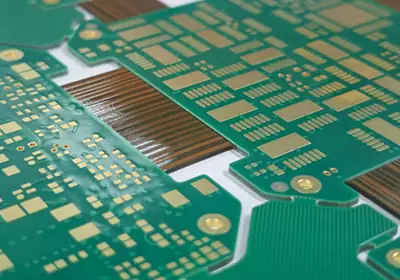
Rogers RO4350B is a ceramic-filled, glass-fiber-reinforced hydrocarbon resin laminate engineered for high-performance, high-frequency PCB applications. It combines the electrical properties of PTFE/glass cloth materials with the processing characteristics of epoxy/glass cloth.
This material is increasingly popular across various high-frequency applications due to its excellent dielectric constant (Dk) stability, low loss tangent (Df), and superior thermal and mechanical properties. RO4350B achieves a seamless balance between high electrical performance and ease of manufacturing, making it an ideal choice for numerous industries ranging from telecommunications and automotive radar systems to aerospace and military systems.
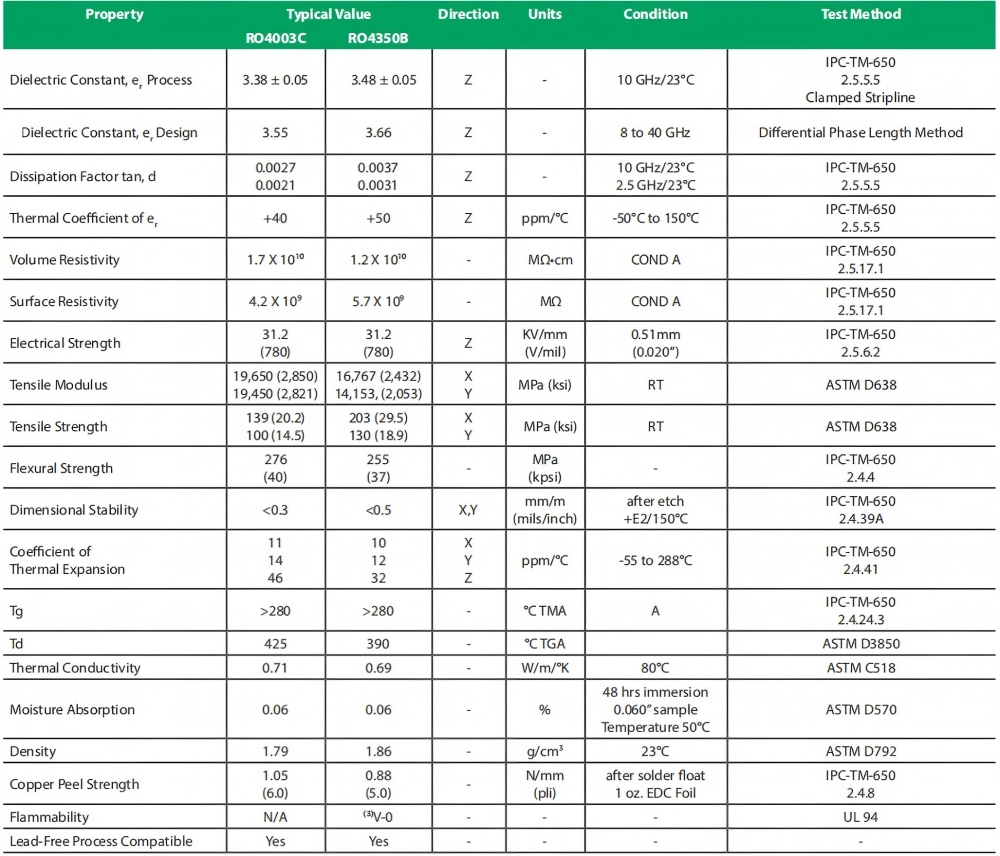
Data Specification Sheet
Rogers RO4350B High-Frequency Sheet Parameters:
1. Stable Dielectric Constant (Dk): At 10GHz, its nominal dielectric constant is 3.48 with minimal variation across frequencies and temperatures. This is critical for ensuring signal integrity, particularly the precision of impedance control.
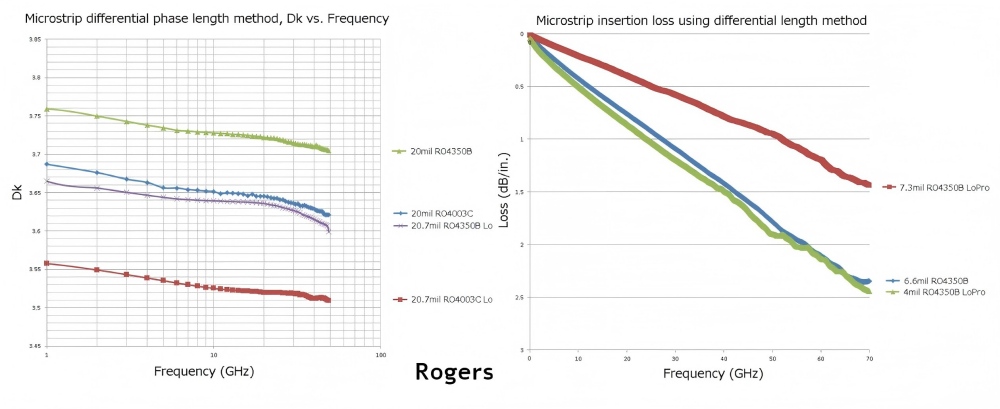
2. Low loss factor (Df): At 10GHz, its loss factor is as low as 0.0037. This minimizes energy loss during signal transmission, making it highly suitable for high-frequency, high-speed applications by effectively reducing signal attenuation and heat generation.
3. High Thermal Conductivity: Its thermal conductivity reaches 0.62 W/m/K, significantly outperforming conventional FR-4. This facilitates rapid heat dissipation during operation, enhancing power handling capability and long-term reliability.
4. Lead-Free Solder Compatibility: It withstands the high temperatures of lead-free soldering processes, meeting modern environmental manufacturing requirements.
These fundamental properties make RO4350B widely used in base station antennas, power amplifiers, automotive radar, low-noise amplifiers (LNAs), and high-speed backplanes.
Core Interpretation of Board Thickness Parameters of Rogers RO4350B:
While “board thickness” appears to be the physical dimension of the material, in high-frequency circuit design, it directly correlates with a series of critical electrical and mechanical properties.
1. Standard Thickness Range: Rogers RO4350B offers a series of standardized thickness options to meet diverse design requirements. Common standard thicknesses include: 0.008 inches (0.203 mm), 0.012 inches (0.305 mm), 0.016 inches (0.406 mm), 0.020 inches (0.508 mm), 0.025 inches (0.635 mm), 0.030 inches (0.762 mm), 0.040 inches (1.016 mm), etc. These thicknesses typically refer to the core material thickness, excluding subsequent laminated copper foil layers.
2. Control of Board Thickness and Characteristic Impedance: This is the most critical consideration in selecting board thickness. For transmission line structures like microstrip or stripline, the formula for calculating characteristic impedance (typically 50 ohms or 100 ohms differential) is closely related to the dielectric thickness (i.e., board thickness) and trace width. With a fixed dielectric constant, achieving the same target impedance requires a wider trace width for thicker boards. Conversely, thinner boards necessitate narrower traces.
a. Thick Board Applications: When transmitting higher power, wider traces can handle greater current, reducing the Joule heating effect. Simultaneously, a thicker dielectric layer can mitigate conductor losses to some extent. Therefore, thicker RO4350B boards are often considered for applications like power amplifiers.
b. Thin Board Applications: For high-density interconnect (HDI) boards, internal circuits in portable devices, or installations requiring fine-pitch BGA packages, physical space constraints necessitate thinner boards to achieve finer routing. Additionally, thin boards offer smaller physical dimensions when constructing compact passive components like couplers and filters.
3. Board Thickness and Mechanical Strength/Rigidity: The thickness of the substrate directly determines the mechanical strength of the circuit board. Thicker substrates (e.g., 1.0mm or above) offer superior rigidity and bending resistance, making them suitable for large, unsupported boards or devices operating in vibrating or impact-prone environments. Thinner substrates (e.g., 0.2mm) are highly flexible, ideal for the rigid sections of flexible or rigid-flex boards, or specialized applications requiring bendable installations.
4. Board Thickness and Thermal Management: Although RO4350B itself exhibits good thermal conductivity, board thickness affects overall thermal resistance. In heat dissipation pathways, thinner boards offer lower thermal resistance, allowing heat to transfer more rapidly from the top copper layer to the backplane or heat sink. However, thicker boards possess greater thermal mass, enabling them to temporarily store more heat and act as a “thermal buffer.” Designers must balance these factors based on specific thermal structures (e.g., use of vias or heat sinks).
5. Board Thickness and Multilayer Structure: In complex multilayer designs, RO4350B is often used as the core laminate. Different thickness combinations determine the spacing between signal layers. Thinner core boards enable tighter interlayer coupling, benefiting high-speed differential signal transmission but increasing the risk of crosstalk. Thicker core boards provide better interlayer isolation.
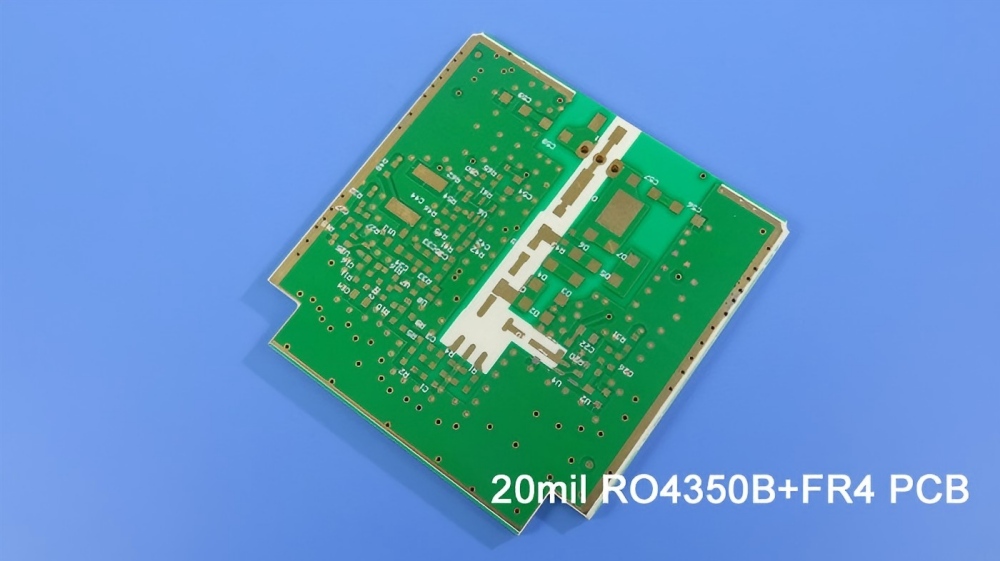
Selecting Suitable PCB Materials: Rogers RO4350B, FR-4, and PTFE
1. Frequency Requirements:
a. RO4350B: Suitable for high-frequency applications (500 MHz to 77 GHz) with stable dielectric constant and low signal loss, ideal for 5G, radar, and microwave systems.
b. FR-4: Best suited for low-frequency designs below 500 MHz where cost is a priority and high-frequency signal attenuation is not a concern.
c. PTFE: Suitable for ultra-high-frequency applications above 10 GHz, offering even lower loss than RO4350B but typically at a higher cost and with more complex processing.
2. Thermal Management:
a. RO4350B: High-temperature resistant with Tg > 280°C, offering better thermal performance than FR-4 but inferior to PTFE.
b. FR-4: Withstands moderate temperatures typically around 130°C-180°C, though performance may degrade under high-temperature conditions.
c. PTFE: Exceptional thermal properties with minimal thermal expansion and high decomposition temperature, enabling reliable operation in demanding high-power RF environments.
3. Cost:
a. RO4350B: A balanced choice offering high-frequency performance at lower cost than PTFE, though more expensive than FR-4.
b. FR-4: Most cost-effective, generally used for low-frequency and budget-conscious designs.
c. PTFE: More expensive than both RO4350B and FR-4 due to superior performance and more complex manufacturing processes.
Rogers RO4350B is suitable for high-frequency, cost-sensitive designs such as RF, 5G, and automotive radar, where performance, stability, and moderate cost are critical. FR-4 is ideal for low-cost, low-frequency applications prioritizing price. PTFE laminates are selected for extremely high frequencies requiring minimal signal loss, though they carry higher costs and more complex manufacturing processes compared to RO4350B and FR-4.
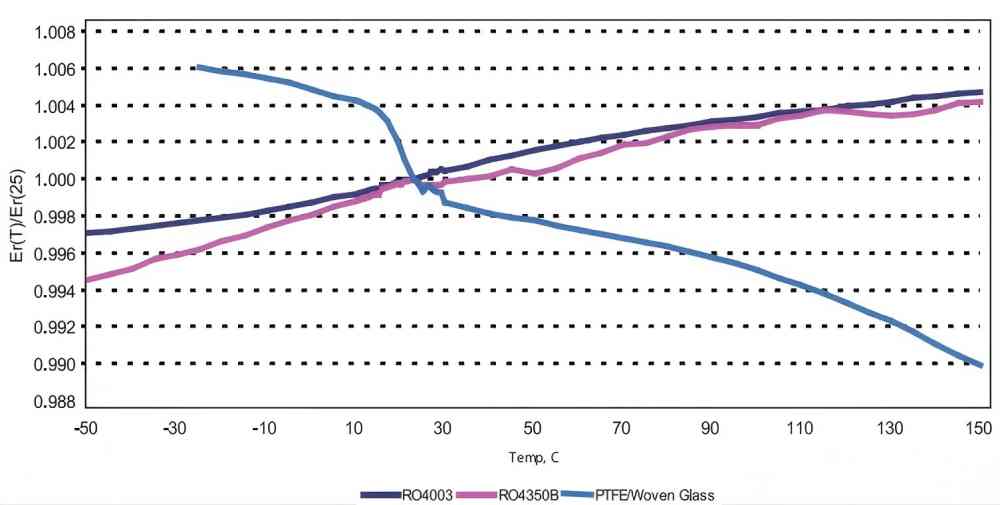
RO4000 Series Sheet Dielectric Constant vs. Temperature Graph
Summary
Rogers RO4350B is the ideal material for high-frequency PCB design, combining exceptional electrical performance, mechanical strength, and cost-effective manufacturing. Its stable dielectric constant, low loss tangent, and excellent thermal properties make it a reliable choice for RF and microwave applications in industries such as telecommunications, automotive, aerospace, and medical equipment. By adhering to appropriate design considerations and processing guidelines, engineers can fully leverage RO4350B's characteristics to create high-performance, reliable electronic systems for next-generation high-frequency technologies.